Year in review: The last 12 months has been big for dementia
Brain health has hit the headlines with significant breakthroughs in diagnosis and treatments

Dementia has surpassed heart disease to become the leading cause of death in Australia, a statistic confirmed by the Australian Bureau of Statistics (ABS).
With over 17,500 deaths attributed to dementia in 2024, accounting for 9.4 per cent of all national deaths, the condition’s impact on the Australian population, particularly on women and those over 75, has driven a number of medical, technological, and social developments throughout the year.
National strategy and prevention efforts
The Albanese government laid a crucial foundation for future action with the release of its National Dementia Action Plan 2024-2034 in December 2024.
This 10-year strategy aims to foster a “dementia inclusive” nation by increasing awareness, reducing risk, and developing better, more coordinated national dementia services.
Minister for Health Mark Butler said “dementia is a national health priority for our government and the National Dementia Action Plan reflects this.”
The plan, developed with input from people living with dementia, outlines eight key actions, including promoting equity and human rights, tackling stigma, empowering risk minimisation, and improving diagnosis, treatment, and workforce capability.
Complementing this national strategy, Australian researchers demonstrated significant progress in prevention.
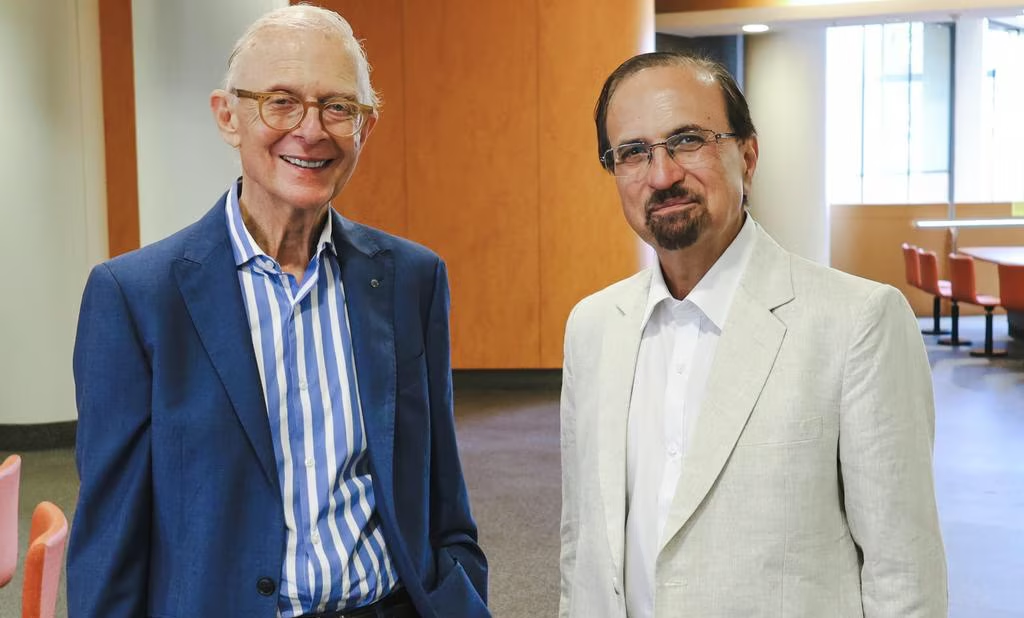
In February, UNSW's Centre for Healthy Brain Ageing (CHeBA) unveiled findings from its Maintain Your Brain study. This clinical trial showed that remote lifestyle intervention programs delivered to older people resulted in “significantly better cognition.”
“The outcome was a resounding yes – we can improve cognition over three years and therefore, likely enhance resilience to dementia,” CHeBA co-director Professor Henry Brodaty AO said.
The online modules targeted physical activity, nutrition, brain training, and mental health. Professor Brodaty noted the intervention's scalability, with potential for “population-level roll out that may delay cognitive decline in the general community,” and highlighted that younger participants (55-65) showed greater benefit, suggesting earlier prevention efforts.
Addressing the National Press Club in July, Professor Brodaty called for a “slip, slop, slap of brain health” approach, advocating for increased funding for dementia research.

Dementia drugs: Access, rejections and approvals
The year presented a complex picture for new Alzheimer’s disease treatments, marked by both regulatory approvals and significant access challenges.
The journey for lecanemab (LEQEMBI) saw a notable shift. In March, the Australian Therapeutic Goods Administration (TGA) confirmed its decision to reject the drug for registration, citing that “the demonstrated efficacy did not outweigh the safety risks associated with the use of this medicine.”
Professor Christopher Rowe, Australian Dementia Network director, argued that with proper monitoring, risks could be mitigated.
"This drug buys valuable time, slowing the rate of progression towards severe dementia by one third,” he said.
However, by September, the TGA reversed its stance, listing lecanemab (LEQEMBI), and Australia became the 50th country to register the drug, a significant development for eligible patients with mild cognitive impairment.
In contrast, donanemab (Kisunla), another new Alzheimer’s treatment, faced a different fate.
While the TGA approved donanemab for use in Australia, the Pharmaceutical Benefits Advisory Committee (PBAC) rejected its inclusion on the Pharmaceutical Benefits Scheme (PBS) in August.
This decision means patients would have to pay privately, with treatment costs ranging from $40,000 to $80,000 a year.
The PBAC stated that while donanemab could potentially delay disease progression, “there is a lack of consensus among clinicians that these results would translate into meaningful improvements for patients.”
Alongside currently approved drugs, a new Alzheimer’s drug, Trontinemab, showed “game-changing” potential in clinical trials presented in July.
This drug cleared harmful brain plaques in 28 weeks, significantly faster than existing treatments, with fewer side effects.
Professor Sir John Hardy, chair of molecular biology of neurological disease at University College London, described it as “absolutely great news.”
A major 18-month trial is now underway to assess its clinical effects.
Research breakthroughs
Beyond drug treatments, 2025 brought advancements in dementia research.
Professor Matthew Kiernan, CEO and institute director of Neuroscience Research Australia (NeuRA), said that the field is “on the brink of massive breakthroughs,” including vaccine research. Pharmaceutical companies like GSK are exploring the possibility of vaccinating children to prevent Alzheimer’s entirely in the future. While still hypothetical, it represents a significant long-term vision.
Closer to implementation are blood tests for dementia diagnosis. Professor Kiernan noted the FDA’s approval of a blood test for the p-tau protein, which can indicate Alzheimer’s up to 10 years before symptoms appear, predicting that within four to five years, such tests could be routinely available through pathology services in Australia, allowing for earlier diagnosis and intervention.
Artificial intelligence (AI) is also a key player in revolutionising dementia diagnosis, with research projects demonstrating AI models capable of predicting the speed of Alzheimer’s development and even the disease’s onset years before symptoms appear.
Professor Kiernan’s overall message was one of optimism and empowerment, as he emphasised that these advancements are “not just talking about improving things for carers or making people comfortable at the end stages of their lives, we’re talking about improving outcomes and brain health for the entire community.”
Email: rebecca.cox@news.com.au